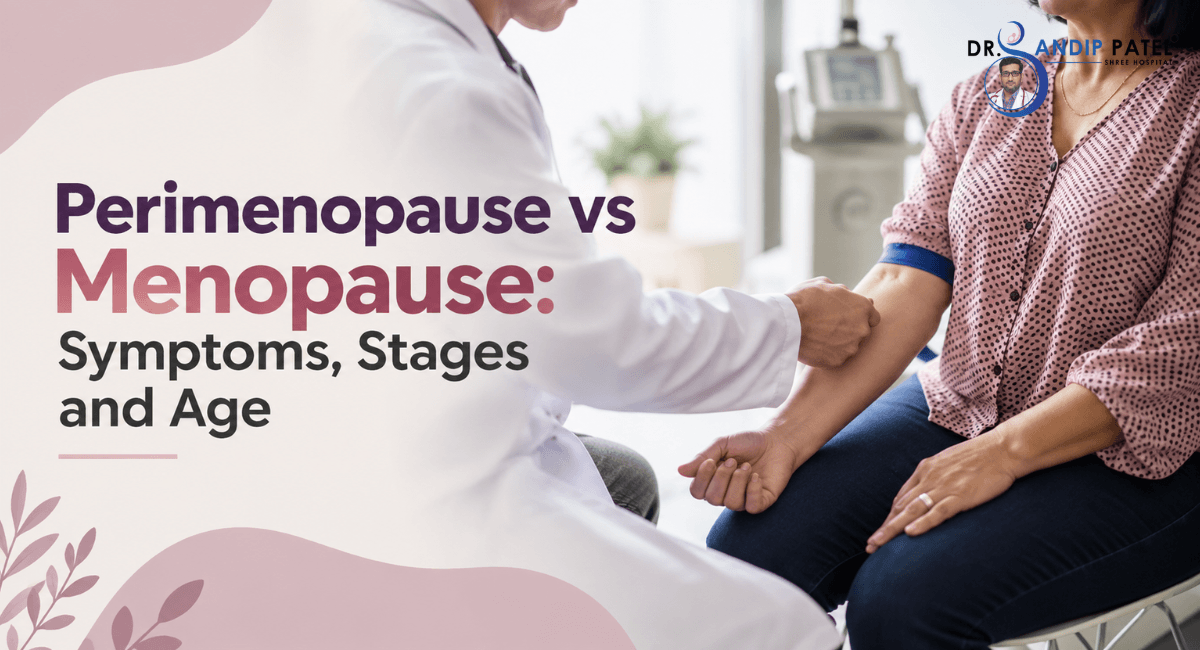
One month your period arrives early. The next month, it is late. You may suddenly wake up feeling hot, struggle to sleep, or notice changes in your mood that seem to come out of nowhere. If these changes sound familiar, you may be wondering: Am I going through perimenopause, or have I reached menopause?
Understanding the difference between perimenopause vs menopause can make these changes easier to understand and manage. Although both are connected to the natural decline in reproductive hormones, they are not the same stage.
Knowing where you are in the menopause transition can also help you understand your symptoms, reproductive health, and when it is appropriate to speak with a gynecologist.
Perimenopause is the period leading up to menopause. It is also called the menopausal transition. During this stage, the ovaries gradually produce changing and eventually lower amounts of estrogen, while menstrual cycles may become less predictable.
Perimenopause does not happen at the same age for everyone. Many women begin noticing changes during their 40s, although symptoms can sometimes appear earlier or later. The transition may continue for several years before menopause occurs.
The important point is that you can still have periods and become pregnant during perimenopause.
The perimenopause symptoms can vary considerably from one woman to another. Some women experience only mild changes, while others experience several symptoms that affect their daily lives.
Common signs may include:
One of the earliest signs of perimenopause is often a noticeable change in the usual menstrual pattern. However, symptoms alone cannot always tell you exactly which stage you are in.
Menopause is different from perimenopause. It is officially reached when a woman has gone 12 consecutive months without a menstrual period, assuming the absence of periods is not caused by another factor such as hormonal contraception.
In other words, menopause is not simply having an irregular period for several months. It is confirmed retrospectively after a full year without menstruation.
After menopause, a woman enters the postmenopausal stage.
The menopause symptoms may overlap with symptoms experienced during perimenopause. These can include:
Not every woman experiences all of these symptoms, and some women have very few noticeable symptoms.
The simplest way to understand the difference between perimenopause and menopause is to look at menstrual patterns.
Perimenopause | Menopause |
Periods may become irregular | Periods have stopped |
Ovulation may still occur | Natural ovulation has stopped |
Pregnancy is still possible | Natural pregnancy is no longer possible |
Hormones fluctuate | Hormone levels have reached a lower post-reproductive state |
Symptoms may come and go | Symptoms may continue even after periods stop |
It occurs before menopause | It is reached after 12 months without a period |
The transition is gradual rather than an overnight change. A woman may experience symptoms for months or years before reaching menopause.
There is no single perimenopause age that applies to every woman.
Many women begin noticing menstrual or hormonal changes in their 40s. However, some may notice changes in their 30s, while others may not experience obvious changes until their 50s.
The timing can be influenced by individual health, genetics and other factors. Therefore, age alone should not be used to determine whether someone is in perimenopause.
If menstrual changes begin unusually early, medical evaluation can help determine whether another condition or early menopause may be involved.
The usual menopause age is around the mid-40s to mid-50s. The National Institute on Aging reports that most women begin the menopausal transition between 45 and 55, with an average menopause age of about 52 in the United States.
However, menopause can occur earlier or later. Early or premature menopause should be discussed with a healthcare professional because it may have implications for bone health, reproductive health, and overall well-being.
The phrase perimenopause stages is often used to describe the gradual progression toward menopause. While there is not one universal system that precisely divides every woman’s experience into identical stages, the transition can generally be understood as a gradual process.
Periods may still occur regularly, but subtle changes can begin. Your cycle may become slightly shorter or longer, or symptoms such as sleep problems and hot flashes may appear.
Periods become increasingly unpredictable. You may skip periods for longer intervals, and symptoms may become more noticeable.
Menopause is reached after 12 consecutive months without a menstrual period, provided there is no other explanation for the absence of periods.
This is the period after menopause. Some symptoms, including hot flashes or vaginal dryness, can continue after periods have stopped.
There is no need to guess based only on one symptom.
Start by tracking your menstrual cycle. Note when your period begins, how long it lasts, whether the flow has changed and whether you are skipping cycles. Also record symptoms such as hot flashes, sleep problems, mood changes and vaginal discomfort.
Your age, menstrual history, and symptoms can help a healthcare professional determine whether you are likely experiencing the menopausal transition. For many women aged 45 or older, routine hormone testing is not necessary for diagnosing typical perimenopause or menopause. However, testing may be considered in certain situations, particularly when menopause occurs unusually early or another medical condition needs to be ruled out.
Menopause is a natural biological process, but that does not mean every symptom should simply be ignored.
Speak with a gynecologist if your symptoms are interfering with sleep, work, relationships or daily activities. Medical advice is particularly important if you experience unusually heavy bleeding, bleeding between periods, bleeding after sexual intercourse or vaginal bleeding after menopause.
Any vaginal bleeding after 12 months without periods should be evaluated by a healthcare professional.
A gynecologist can also discuss lifestyle changes and appropriate treatment options. Depending on your symptoms and medical history, management may include lifestyle measures, non-hormonal medicines, or hormone-based treatment where medically appropriate.
Yes. Fertility generally declines as women approach menopause, but pregnancy can still occur during perimenopause because ovulation may continue unpredictably.
If you are trying to conceive and experiencing irregular periods, it is worth discussing your reproductive health with a fertility specialist or gynecologist rather than assuming that irregular cycles automatically mean pregnancy is impossible.
For women and couples who need fertility assistance, treatment options can vary depending on age, ovarian function, sperm health, ovulation, and other medical factors. Shree Hospital provides fertility services including evaluation, IUI, and IVF treatment in Anklav.
The IVF treatment cost in Anklav is not the same for every patient. It can depend on the medications required, treatment protocol, number of cycles and additional procedures such as ICSI or embryo freezing.
Shree Hospital states that an individualized fertility consultation is used to determine an estimated cost according to the patient’s medical requirements.
This is why it is better to discuss your medical history and fertility goals with a specialist before comparing treatment costs alone.
Choosing the best gynecologist in Anklav should involve more than simply looking for a convenient location. Consider the doctor’s experience, the range of women’s health services available, diagnostic facilities, communication style and whether treatment recommendations are personalized to your health needs.
Shree Hospital in Anklav provides gynecology and women’s healthcare services covering menstrual concerns, hormonal disorders, ovarian and uterine conditions, pregnancy care, infertility treatment, and advanced gynecological procedures.
Perimenopause vs menopause is not simply a question of whether your periods are regular or not. It is about understanding how your body is changing and recognizing when professional guidance can make the transition easier.
Irregular periods, hot flashes, sleep changes and mood fluctuations can be part of the menopause transition, but persistent or unusual symptoms deserve proper evaluation. Keeping track of your cycle and symptoms can give your gynecologist valuable information and help you understand whether you are experiencing perimenopause, menopause or another health concern.
At Shree Hospital, Anklav, women can access personalized gynecological care, hormonal health management, fertility services and other women’s health treatments under professional medical guidance. If you are experiencing changes associated with perimenopause or menopause, scheduling a consultation can help you understand what is happening and discuss appropriate options for your individual needs.
Your changing body deserves understanding, not confusion. Early guidance can help you move through every stage of women’s health with greater confidence and informed care.
The best laparoscopic surgeon in Anklav is one with proven experience, advanced surgical skills, and a patient-first approach. At Shree Hospital, Dr. Sandip Patel is known for his expertise in minimally invasive gynec surgery and consistent outcomes.
Laparoscopic surgery is commonly used to treat ovarian cysts, fibroids, endometriosis, ectopic pregnancy, and infertility-related conditions. It is also used for diagnosis in certain unclear cases.
Yes, laparoscopic surgery is considered very safe when performed by an experienced laparoscopy specialist. It involves smaller cuts, less pain, and a lower risk of complications compared to open surgery.
Recovery is usually faster than traditional surgery. Most patients can return to normal activities within a few days to a week, depending on the procedure and individual health.
Look for a qualified surgeon with experience in advanced laparoscopic procedures, positive patient outcomes, and access to a well-equipped hospital. Personal consultation also helps you feel confident and informed before treatment.
Let’s discuss your fertility goals and create a personalized treatment plan for you.